
BLOG
How Custom Driveline Parts Are Inspected and Tested
October 28,2026
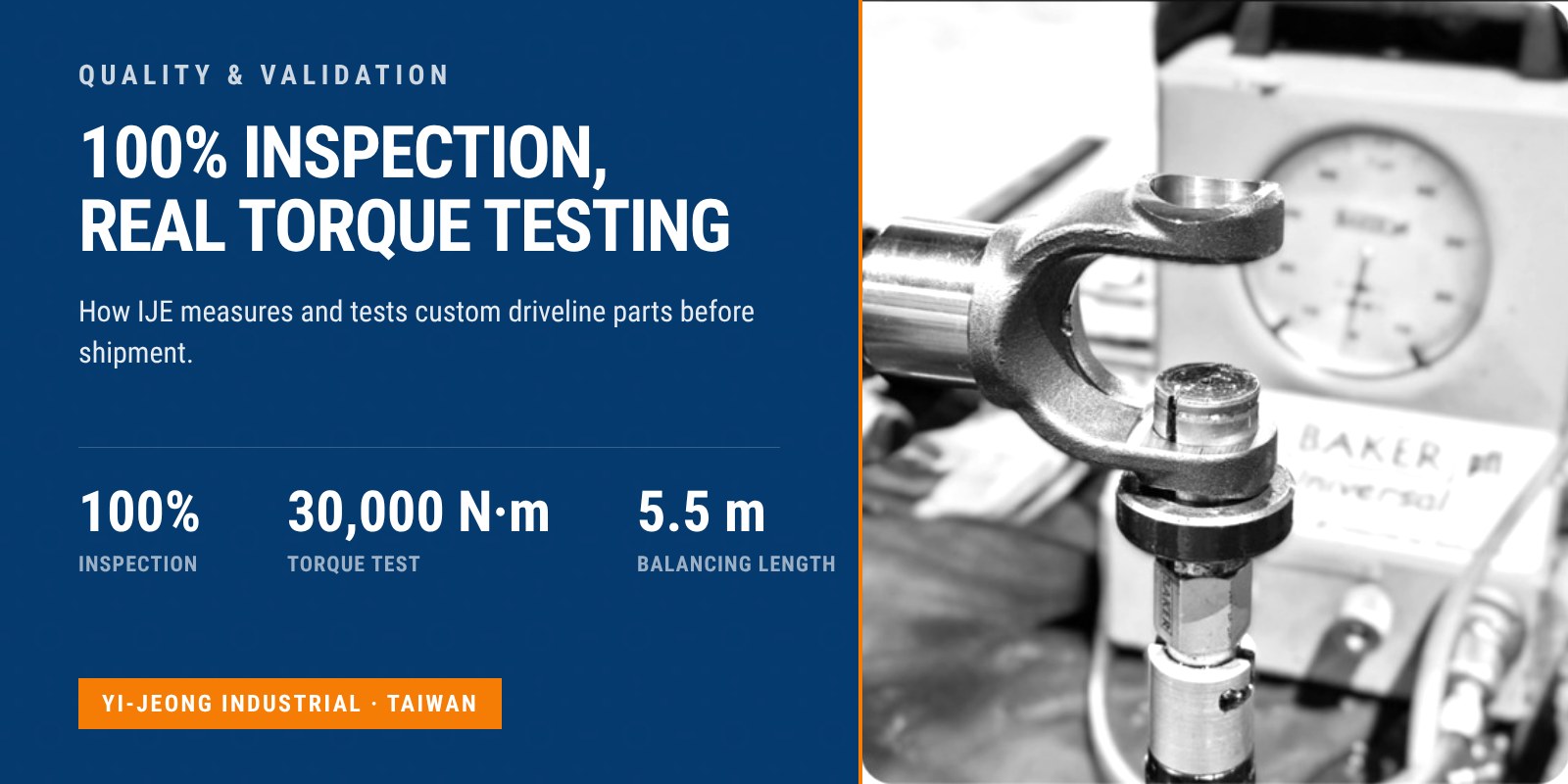
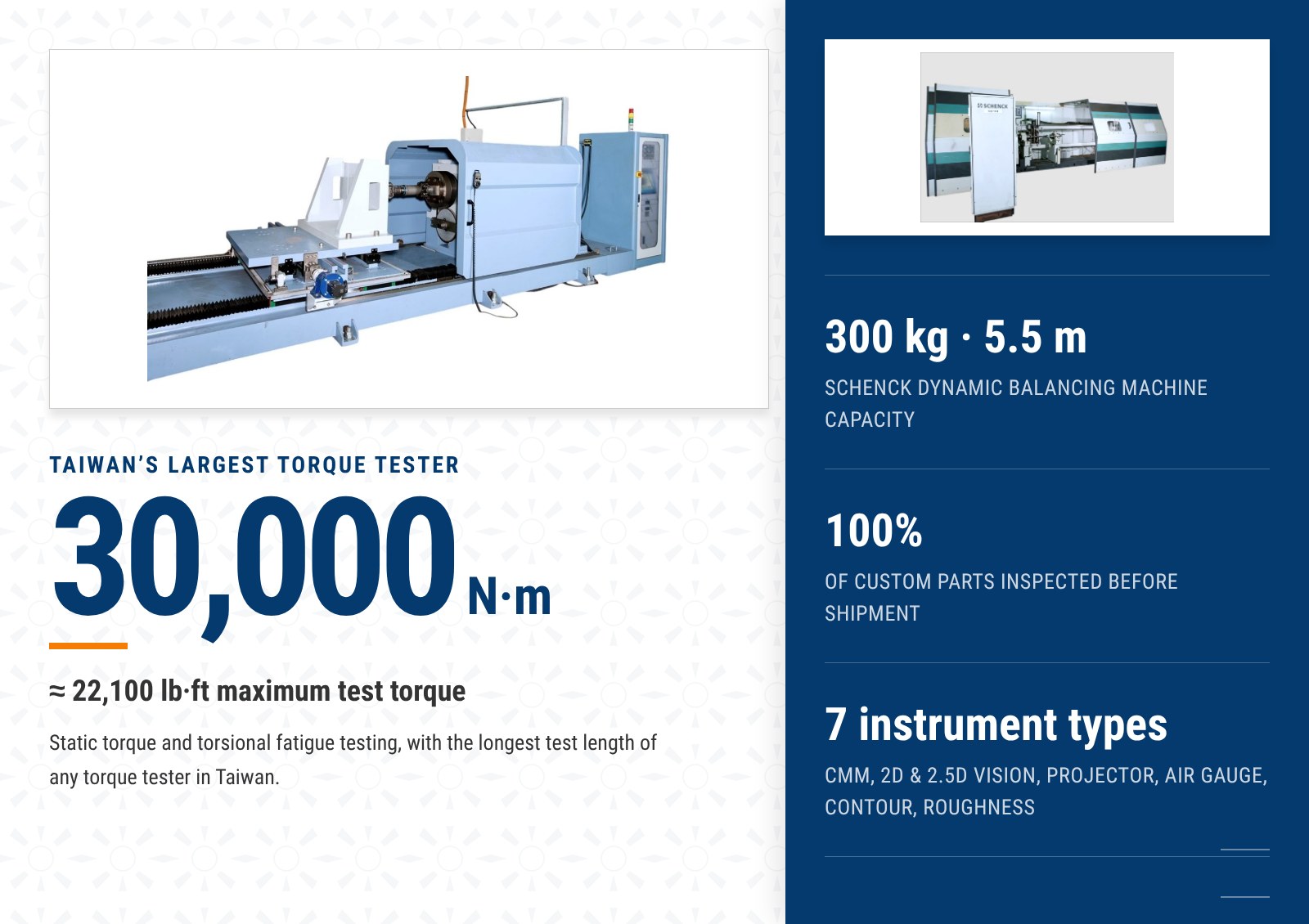
At YI-JEONG Industrial (IJE) in Taichung, Taiwan, every custom driveline part is 100% inspected before shipment, and parts or assemblies can be validated in house with torque, fatigue, durability and dynamic balance testing. IJE operates the largest torque testing system in Taiwan, with a capacity of 30,000 N·m (about 22,100 lb·ft) and the longest test length in the country, and a Schenck dynamic balancing machine for shafts up to 300 kg and 5.5 m long. This article explains what each measurement and test checks, so you know what to ask for when you order a custom part.
Key points
- Custom parts are 100% inspected, not sampled.
- Seven types of measuring instruments, each matched to the features it checks best.
- Static torque, torsional fatigue, durability and dynamic balance testing in IJE’s own lab.
- Same methods and equipment as IJE’s OEM programs; ISO 9001 certified.
Why does a custom part need 100% inspection?
In mass production, a stable process and sampling inspection are usually enough. A low-volume custom part is different: the batch is small, the setup is new and one bad part can stop a vehicle build. For that reason IJE measures every custom part, not only a sample from the batch, and checks it against the customer’s drawing or approved sample.
Which instrument measures which feature?
No single instrument can check every feature of a driveline part. The diagram shows a slip yoke as an example; the table lists the measuring equipment in our quality lab and what each one is used for.
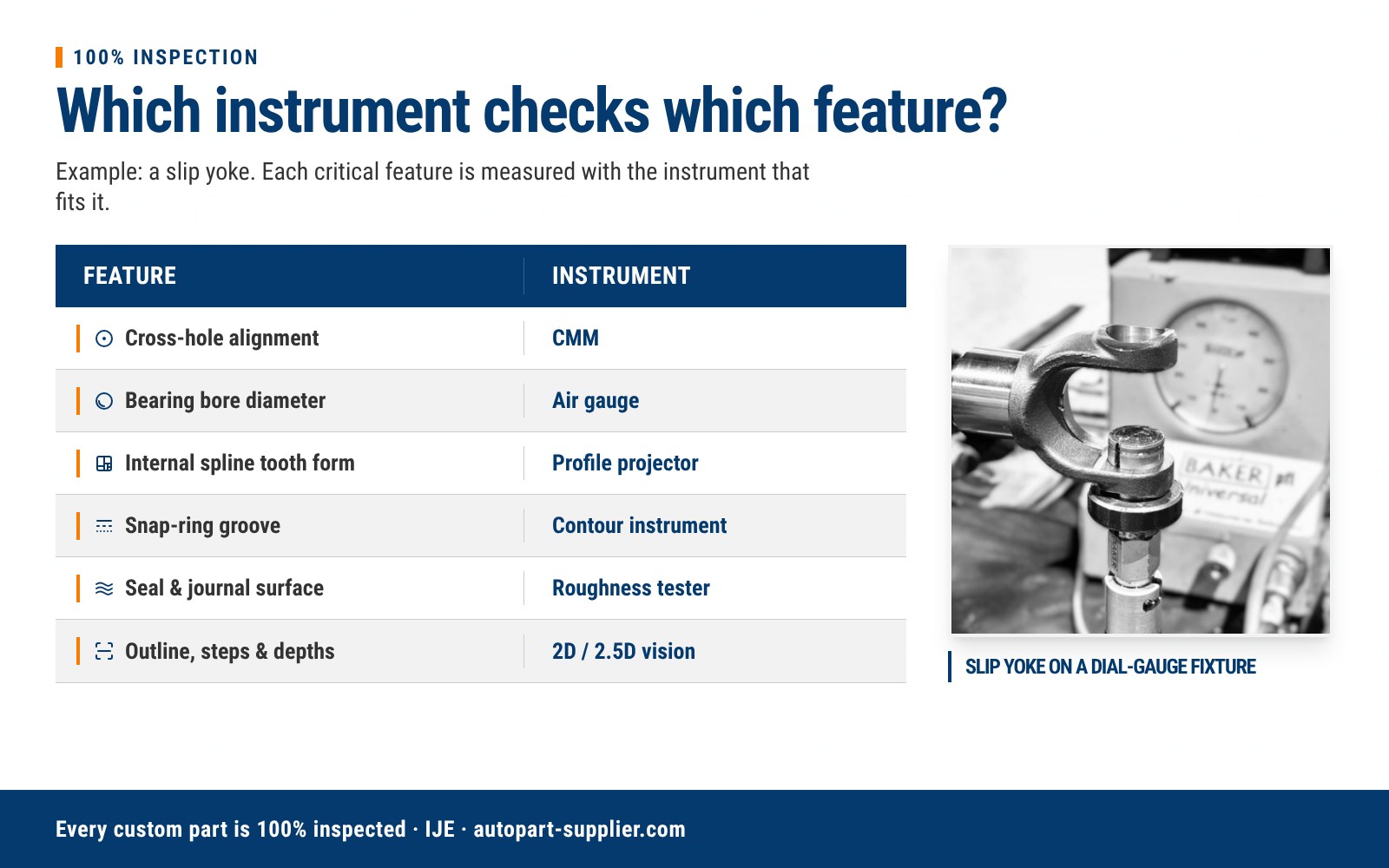
| Instrument | What it measures | Typical driveline features |
|---|---|---|
| Coordinate measuring machine (CMM) | 3D position, form and orientation | Cross-hole alignment in yoke ears, flange bolt circles, perpendicularity |
| 2D vision measuring system | Non-contact 2D dimensions and positions | Small parts, hole patterns, outline dimensions |
| 2.5D vision measuring system | 2D vision measurement plus height (Z axis) | Steps, shoulders and depths on machined parts |
| Profile projector | Magnified profile compared with a template or drawing | Spline and gear tooth form, thread form, radii |
| Air gauge | Bore and shaft diameters, non-contact, fast | Bearing bores, cross holes and precision diameters |
| Contour measuring instrument | Profile, radius and angle traced by a stylus | Snap-ring grooves, fillets, chamfers |
| Surface roughness tester | Surface finish (for example Ra, Rz) | Bearing journals, seal surfaces, spline flanks |
Why several instruments for one spline? On internal splines, for example in slip yokes and steering joints, the profile projector checks the tooth form, while the fit is typically confirmed with spline gauges or measurement over pins.
What does each performance test prove?
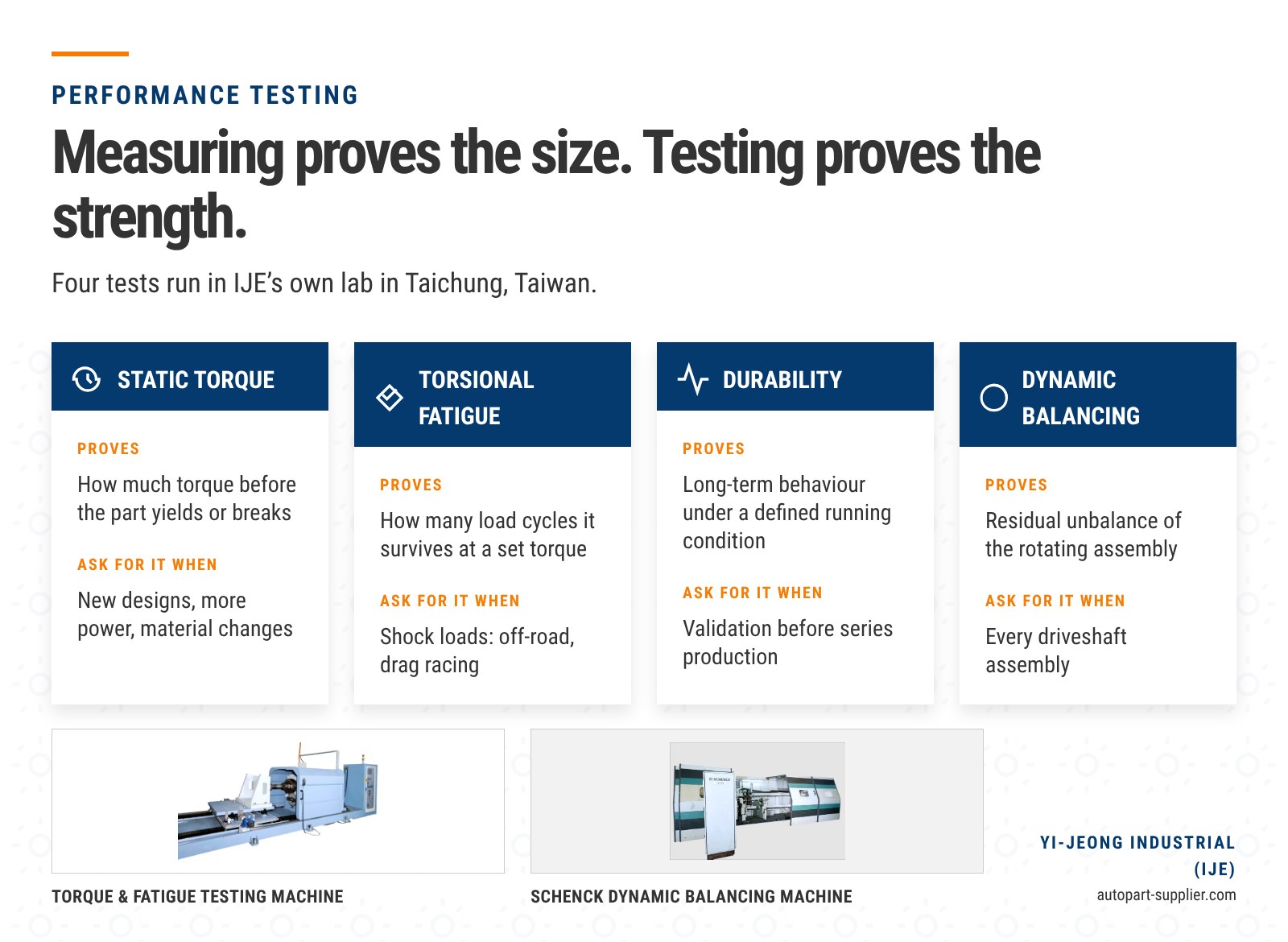
Dimensional inspection confirms that a part matches the drawing. Performance testing confirms that the design is strong enough for the application.
| Test | What it proves | When to ask for it |
|---|---|---|
| Static torque test | The torque the part or assembly can carry before yielding or breaking | New designs, higher-power builds, material or heat-treatment changes |
| Torsional fatigue test | How many load cycles the part survives at a given torque | Parts that see repeated shock loads, such as off-road and drag racing |
| Durability test | Long-term performance under a defined running condition | Validation before series production |
| Dynamic balancing | Residual unbalance of the rotating assembly | Every driveshaft assembly, to reduce vibration |
Taiwan’s largest torque testing system: 30,000 N·m
IJE installed the largest torque and fatigue testing machine in Taiwan in 2015. It has a capacity of 30,000 N·m and the longest test length in Taiwan. The system records operating and peak torque, and the results are used to confirm safety margins and to optimize designs before production.
Dynamic balancing on a Schenck machine
Driveshafts are balanced as complete assemblies on a German-made Schenck dynamic balancing machine, which handles shafts up to 300 kg and 5.5 m long. A well-balanced driveshaft reduces vibration and extends the life of the U-joints, transmission and axle bearings. More about balancing and critical speed is in our propeller shaft design tools.
What does OEM experience add to a custom order?
IJE has supplied OEM parts to vehicle manufacturers in the United States, Japan, Europe and Taiwan for many years. The same inspection methods, gauges and test equipment used for OEM programs are applied to low-volume custom parts. IJE’s quality management system is certified to ISO 9001.
What should you ask for in your quotation request?
Critical dimensionsWhich dimensions must appear in the inspection report.
Inspection reportWhether you need a report with each shipment.
Performance testsWhich tests the part must pass, with target torque, cycles or balance grade if you have them.
First-article approvalWhether first parts should be sent to you before production starts.
If you are not sure which tests your part needs, describe the application, power and torque, and our engineers will suggest a test plan.
Frequently asked questions
Does IJE inspect every custom part?
Yes. Custom parts are 100% inspected before shipment.
What is the capacity of IJE’s torque testing system?
30,000 N·m (about 22,100 lb·ft). It is the largest torque testing system in Taiwan and has the longest test length in Taiwan.
Can a complete driveshaft be balanced?
Yes. Complete assemblies up to 300 kg and 5.5 m long are balanced on a Schenck dynamic balancing machine.
Can I discuss testing requirements at SEMA Show 2026?
Yes. Our team will be at booth #20165, Las Vegas Convention Center, November 3–6, 2026.
Need a part inspected and tested to your requirements?
Contact us with your drawing and test targets. Read also: low-volume custom driveline parts from your drawing.
#20165SEMA Show 2026
Nov 3–6 · Las Vegas
Nov 3–6 · Las Vegas