
BLOG
Low-Volume Custom Driveline Parts from Your Drawing
October 28,2026
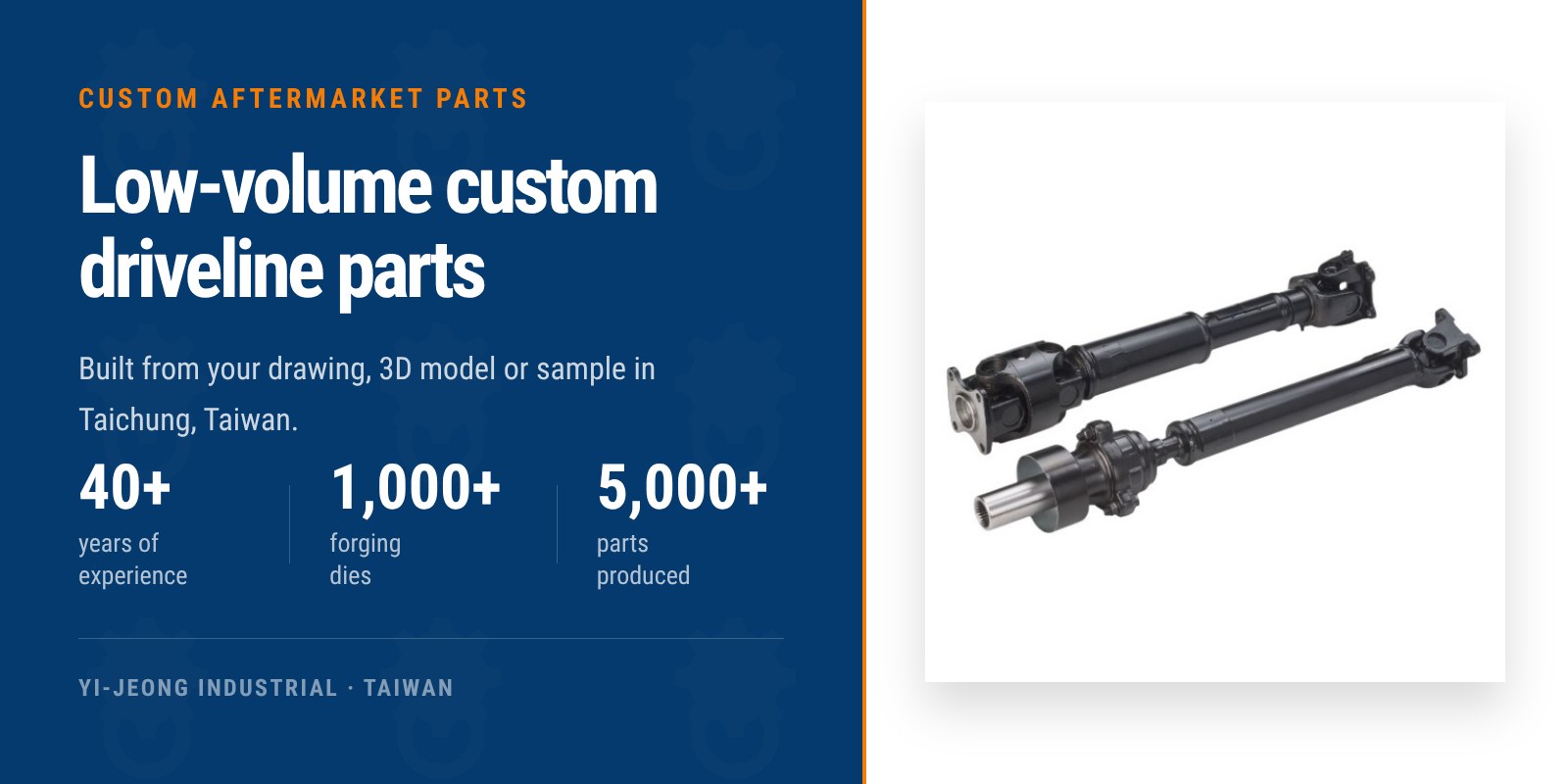
YI-JEONG Industrial (IJE), a driveshaft and universal joint manufacturer in Taichung, Taiwan, builds custom aftermarket and performance driveline parts in low volumes from the customer’s own drawing, 3D model or sample. With more than 40 years of manufacturing experience, more than 1,000 sets of company-owned forging dies and machining, inspection and testing equipment in one factory, IJE can take a one-off design from first prototype to repeat production. You can discuss your project with us at SEMA Show 2026, booth #20165, November 3–6 in Las Vegas.
40+years of driveline manufacturing
1,000+sets of IJE-owned forging dies
5,000+different parts produced
100%inspection of custom parts
Key points
- Low-volume custom parts built from your drawing, 3D model or sample.
- An existing IJE forging die can remove the cost of developing a new die.
- Ten machining, welding and marking processes in one factory.
- Every custom part is inspected; torque, fatigue and balance testing are available in house.
Who needs low-volume custom driveline parts?
Most aftermarket projects never reach the quantities that large parts makers are set up for. For these customers the question is not only “can it be made?” but “can it be made in small quantities, to my drawing, at OEM quality?”
Driveshaft shops and buildersYokes, stub shafts or flanges that are not in any catalog.
Off-road, truck and performance brandsTheir own version of a part, with their own dimensions and part marking.
Restomod and hot rod buildersEngine, transmission and axle combinations that no stock driveshaft or steering shaft fits.
Second-source buyersA replacement source for a part that is no longer made or costs too much to buy.
How does a custom part go from drawing to production at IJE?
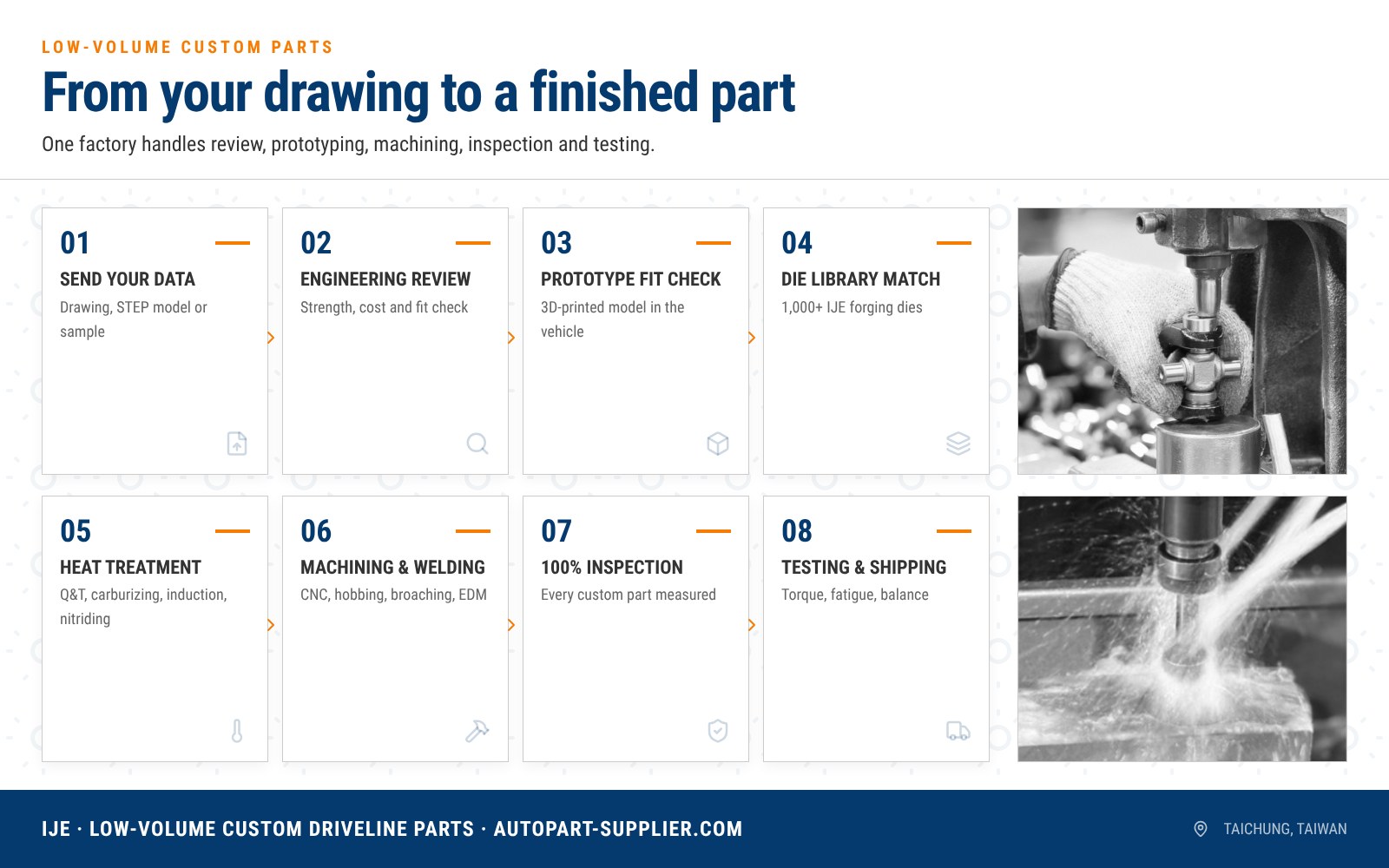
- Send your data. A 2D drawing, a 3D model or a sample, plus quantity and application.
- Engineering review. Our engineers check the drawing against the application and suggest changes that improve strength or reduce cost, for example a standard spline or joint series instead of a special one.
- Prototype and fit check. 3D-printed models confirm fit and clearance in the vehicle before any metal is cut.
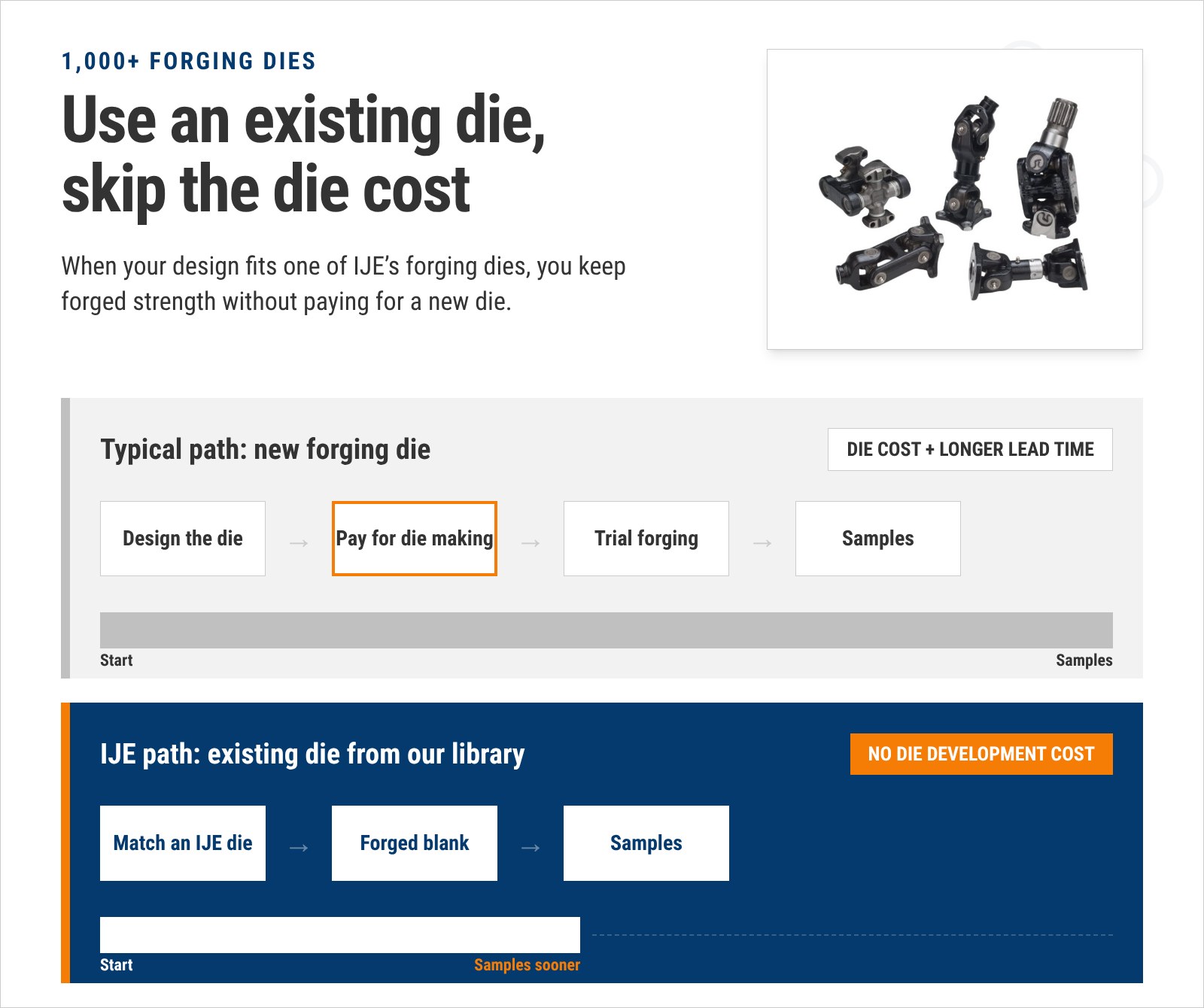
- Tooling decision. We first look for a match in our library of more than 1,000 sets of forging dies. If an existing die fits, the part starts from a forged blank and you save the cost and lead time of a new forging die. If not, low quantities can be machined from bar stock.
- Heat treatment. Each part receives the heat treatment its application needs, carried out by specialist heat-treatment partners to IJE specifications: quenching and tempering, normalizing, carburizing, high- and low-frequency induction hardening, and nitriding.
- Machining, welding and marking. All machining steps, welding and laser marking are done in the same factory.
- 100% inspection. Every custom part is measured before shipment, not only a sample from the batch.
- Testing. When the application calls for it, parts or assemblies are torque tested, fatigue tested and dynamically balanced in house. See how custom driveline parts are inspected and tested.
How do 1,000 forging dies lower the cost of a custom part?
For a new forged part, developing the forging die is often the largest start-up cost and adds weeks to the schedule. IJE owns more than 1,000 sets of forging dies for yokes, flanges, stub shafts and other driveline parts. When your design can start from one of these existing forgings, you pay no die development cost, samples are ready sooner, and you still get the grain flow and strength of a forged part instead of a part machined from bar.
Which machining processes are available in house?
Keeping the process chain in one factory shortens lead time and avoids the tolerance problems that appear when a part travels between several subcontractors.
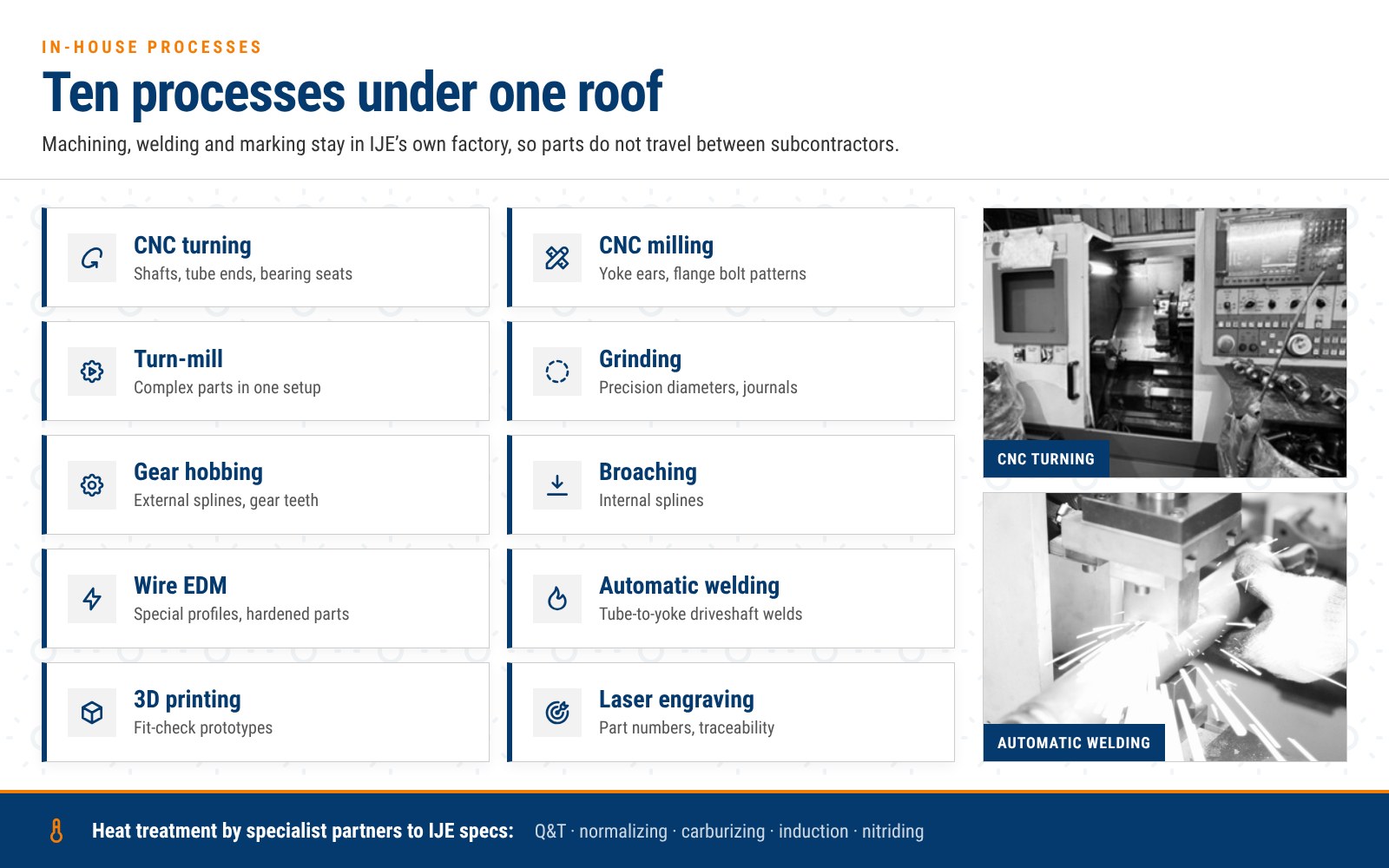
| Process | Equipment | Typical driveline features |
|---|---|---|
| Turning | CNC lathes | Shafts, stub shafts, tube ends, bearing seats |
| Milling | CNC milling machines | Yoke ears, flange bolt patterns, flats and slots |
| Turn-mill | Turn-mill (mill-turn) centers | Complex parts finished in one setup for better concentricity |
| Grinding | Grinding machines | Precision diameters and bearing journals |
| Gear and spline cutting | Gear hobbing machines | External splines and gear teeth |
| Broaching | Broaching machines | Internal splines in slip yokes and steering joints |
| Wire EDM | Wire-cut EDM machines | Special profiles, hardened parts and tooling |
| Welding | Automatic welding machines | Tube-to-yoke welds on driveshaft assemblies |
| Prototyping | 3D printers | Fit-check models, fixtures and gauges |
| Marking | Laser engraving machines | Part numbers, logos and traceability codes |
More about our factory is on the capability page.
What should you send for a custom part quotation?
A complete request lets us check manufacturability and quote faster.
| Information | Why it matters |
|---|---|
| 2D drawing (PDF) and 3D model (STEP) | Defines dimensions, tolerances and critical features |
| Physical sample, if there is no drawing | We can measure the sample and prepare a drawing for your approval |
| Material and heat treatment requirements | Determine strength, wear resistance and cost |
| Quantity per order and per year | Decides whether a part is machined from bar or made from a forging |
| Application, torque and speed | Lets us suggest a suitable joint series, tube size and test plan |
| Marking, finish and packaging | Part numbers, logos, coating and labels for your brand |
Tip for driveshafts: our free propeller shaft design tools check U-joint operating angle and critical speed and create a quotation summary you can attach to your request.
Why does 40 years of production experience matter for a one-off part?
A custom part is new to the customer, but it rarely is new to the factory. In more than 40 years IJE has produced more than 5,000 different parts, from universal joints and driveshafts to steering shafts, forklift driveshafts and industrial universal joints. That record gives us proven materials, heat-treatment specifications and fixtures for most driveline geometries. It is also why a small order can be built to the same standard as the OEM parts we supply to vehicle manufacturers in the United States, Japan, Europe and Taiwan.
Frequently asked questions
Can IJE make a custom part from a sample without a drawing?
Yes. We can measure the sample, prepare a drawing and send it to you for approval before production.
Do I have to pay for a new forging die for a small order?
Often not. We first check our library of more than 1,000 forging dies; if one fits, there is no die development cost. If no die fits, small quantities can be machined from bar stock, and a new die can be considered when volumes grow.
Is every custom part inspected?
Yes. Custom parts are 100% inspected before shipment.
What heat treatments are available for custom parts?
Quenching and tempering, normalizing, carburizing, high- and low-frequency induction hardening, and nitriding, carried out by specialist heat-treatment partners to IJE specifications.
Can I meet IJE at SEMA Show 2026?
Yes. Visit booth #20165 at the Las Vegas Convention Center, November 3–6, 2026. Bring your drawing or sample and we will review it at the booth.
Have a part in mind?
Send us your drawing or sample details for a quotation, or bring them to our booth at SEMA Show 2026.
#20165SEMA Show 2026
Nov 3–6 · Las Vegas
Nov 3–6 · Las Vegas